

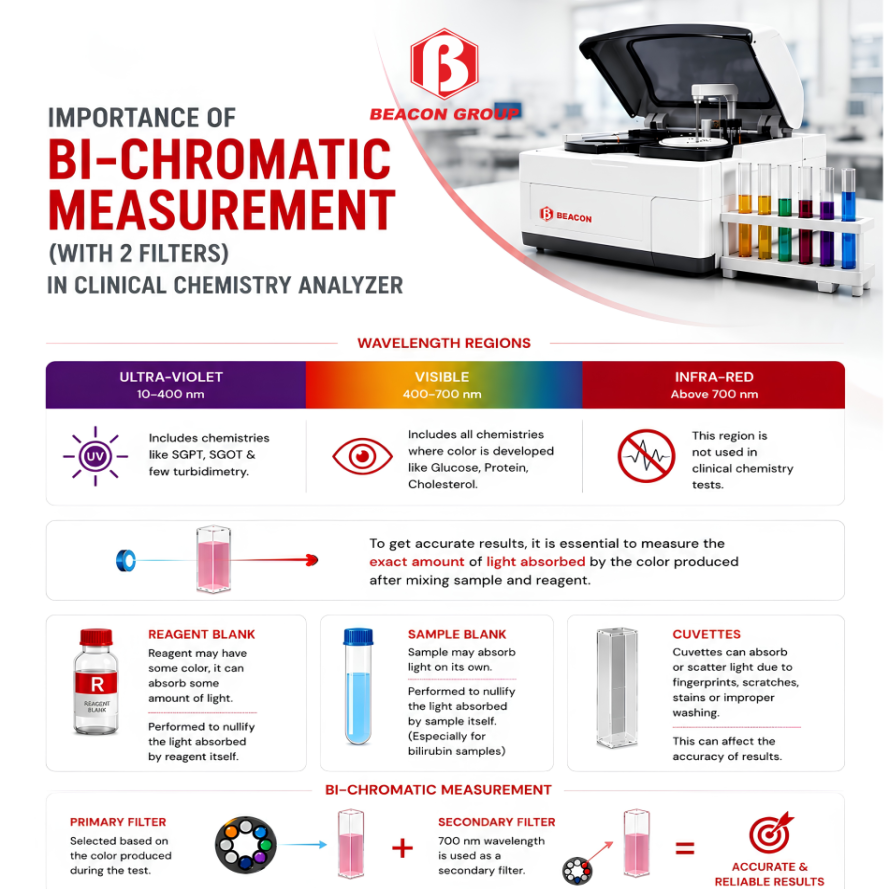
Generally, clinical chemistry analyzers are equipped with 8~10 filters of different wavelengths, starting from 340 nm to 700 nm (nanometer).
To get accurate results in clinical chemistry tests, we need to know the exact amount of light absorbed by the color produced after mixing sample and reagent. If light is absorbed by reagent or sample without mixing them, it may reduce the accuracy of final result.
As reagent itself may have some color, it can absorb some amount of light. So, reagent blank is performed to nullify the light absorbed by reagent itself, without mixing it with sample. Same way, sample blank is performed to nullify the light absorbed by sample itself, without mixing it with reagent (specifically for bilirubin samples).
Now comes the third part, which is generally neglected but it can also reduce the accuracy of final result, the cuvettes. Yes, cuvettes can also absorb or scatter some light mainly due to factors like finger prints, scratches, little stain due to improper washing.
To nullify the light, absorb or scatter by any factor related to cuvettes, bi-chromatic measurement is recommended. In bi-chromatic measurement absorbance is measured with two different filters (wavelengths), primary filter selected based on type of color produced during test and 700 nm wavelength as a secondary filter, to ensure accuracy in final results.
Beacon group of companies are offering full range of semi & fully automatic clinical chemistry analyzers equipped with bi-chromatic measurement.

Beacon Group
424, New GIDC, Kabilpore, Navsari, Gujarat 396424 India

Beacon Diagnostics Europe Srl.
Via Aliprandi 41, 20851, Lissone(MB), Italy

Beacon Diagnostics - Spain
C/Sicilia 159, 08013, Barcelona, Spain

Beacon Diagnostics-Philippines
Unit 108 Two Premier 1st St. Alabang Premier, Alabang Zapote Rd, Concha Cruz Drive, Almanza Uno, Las Pinas City