

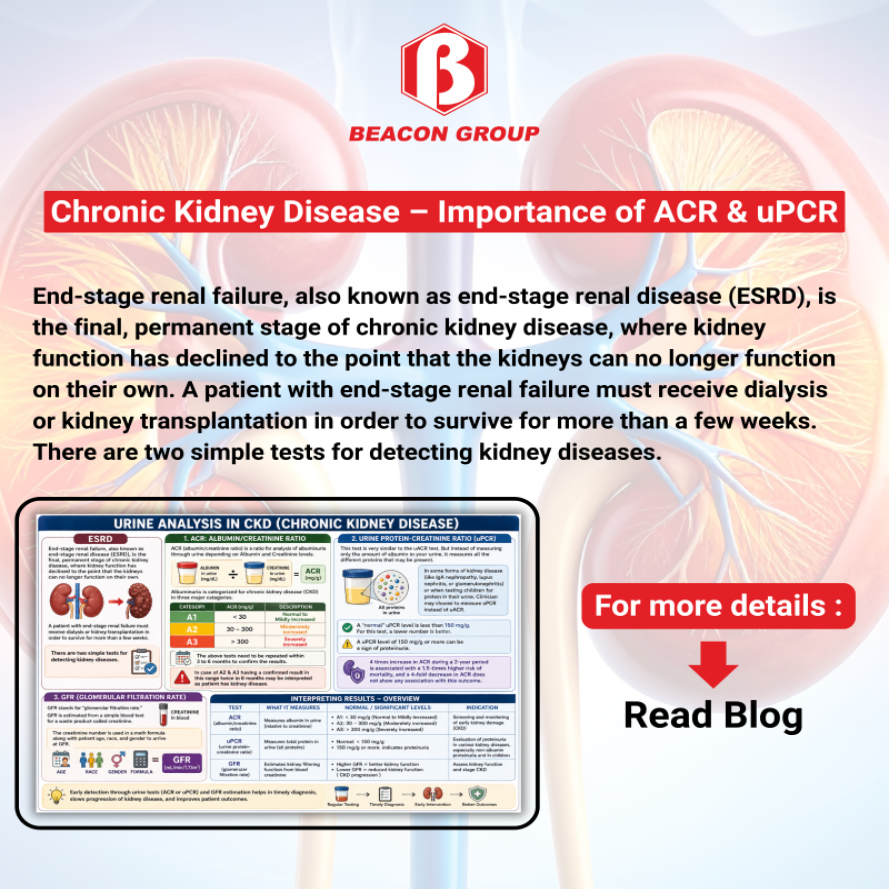
Urine Analysis in CKD (Chronic Kidney Disease)
ESRD
End-stage renal failure, also known as end-stage renal disease (ESRD), is the final, permanent stage of chronic kidney disease, where kidney function has declined to the point that the kidneys can no longer function on their own. A patient with end-stage renal failure must receive dialysis or kidney transplantation in order to survive for more than a few weeks. There are two simple tests for detecting kidney diseases.
ACR:
ACR “albumin/creatinine ratio” is a ratio for analysis Albuminuria through urine depending on Albumin and Creatinine levels. Albuminuria is categorized for chronic kidney disease (CKD) in three major categories.
A1 ≈ < 30; Normal to Mildly increased. A2 ≈ 30 - 300; Moderately increased. A3 ≈ > 300; Severely increased.
The above tests need to be repeated within 3 to 6 months to confirm the results.
In case of A2 & A3 having a confirmed result in this range twice in 6 months may be interpreted as patient has kidney disease.
Urine protein-creatinine ratio (uPCR)
This test is very similar to the uACR test. But instead of measuring only the amount of albumin in your urine, it measures all the different proteins that may be present. In some forms of kidney disease (like IgA nephropathy, lupus nephritis, or glomerulonephritis) or when testing children for protein in their urine, Clinician may choose to measure uPCR instead of uACR. A “normal” uPCR level is less than 150 mg/g. For this test, a lower number is better.
A uPCR level of 150 mg/g or more can be a sign of proteinuria.
4 times increase in ACR during a 2-year period is associated with a 1.5-times higher risk of mortality, and a 4-fold decrease in ACR does not show any association with this outcome.
GFR stands for “glomerular filtration rate.”
GFR is estimated from a simple blood test for a waste product called creatinine. The creatinine number is used in a math formula along with patient age, race, and gender to arrive at GFR.

Beacon Group
424, New GIDC, Kabilpore, Navsari, Gujarat 396424 India

Beacon Diagnostics Europe Srl.
Via Aliprandi 41, 20851, Lissone(MB), Italy

Beacon Diagnostics - Spain
C/Sicilia 159, 08013, Barcelona, Spain

Beacon Diagnostics-Philippines
Unit 108 Two Premier 1st St. Alabang Premier, Alabang Zapote Rd, Concha Cruz Drive, Almanza Uno, Las Pinas City