

(continue from Blog 5 26-27)
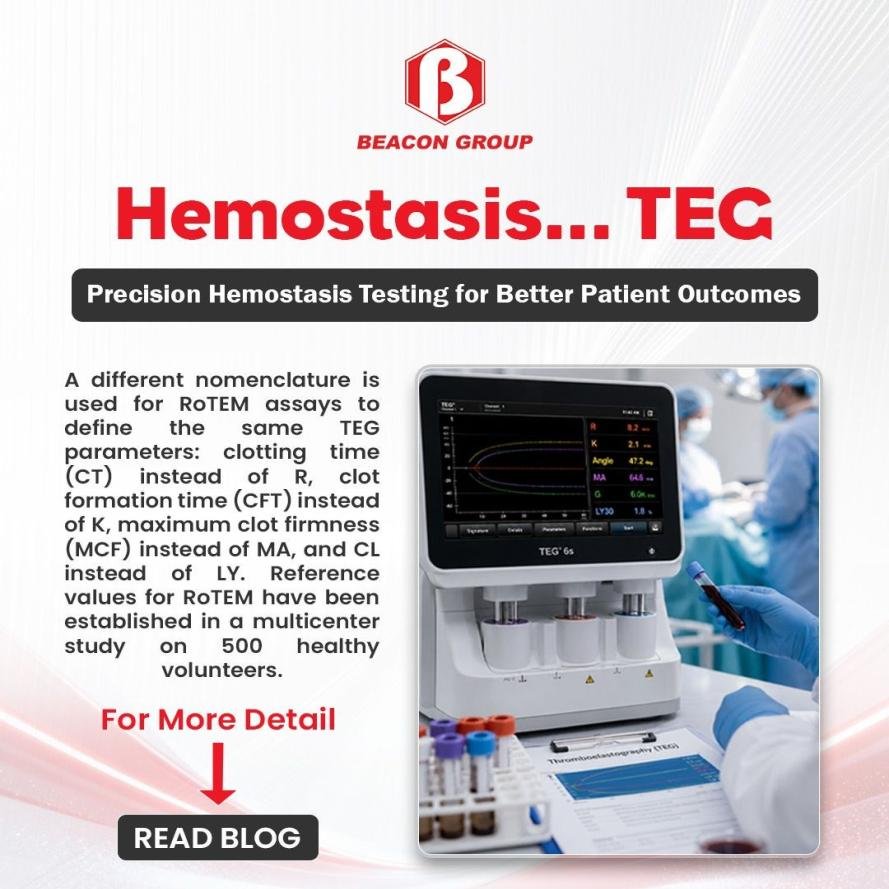
A different nomenclature is used for RoTEM assays to define the same TEG parameters: clotting time (CT) instead of R, clot formation time (CFT) instead of K, maximum clot firmness (MCF) instead of MA, and CL instead of LY. Reference values for RoTEM have been established in a multicenter study on 500 healthy volunteers. Depending on the specific TEG analyzer (TEG versus RoTEM) and reagents being used, differing results may be obtained from the same blood sample, potentially affecting clinical decision-making. Some of these differences are not well understood. For example, NATEM may be more sensitive to hyperfibrinolysis than INTEM and EXTEM. A systematic review of four clinical trials comparing TEG and RoTEM found clinically significant differences between the 2 tests with a lack of comparability of the results. A recent systematic review did not discover a sufficient number of well-designed studies to compare the results of TEG and RoTEM in healthy subjects. Hence, the results of different modifications of TEG and RoTEM cannot be considered interchangeable until head-to-head prospective comparative studies are performed.
Clinical Significance
The main advantage of TEG testing is its potential to deliver immediate goal-oriented and individualized care to a bleeding patient:
TEG has convincingly demonstrated its usefulness to help improve outcomes in cardiac surgery. A meta-analysis of 17 randomized controlled trials (RCTs) demonstrated that TEG decreases blood product transfusions and surgical re-exploration due to postoperative bleeding in cardiac surgery patients. These effects were associated with a lower incidence of acute kidney injury and thromboembolic events. Another systematic review of 17 RCTs involving 1493 patients, mainly elective on-pump cardiac surgery, revealed that TEG/RoTEM decreases transfusion of blood components and reduces overall mortality. The quality of the included studies, however, was considered to be low. A recent RCT found that intraoperative correction of coagulopathy guided by EXTEM and FIBTEM can reduce postoperative bleeding, blood transfusions, and duration of critical care in pediatric cardiac surgery patients.
TEG is also a more cost-effective method compared to standard coagulation tests in the diagnosis of coagulopathy in cardiac surgery.
There is conflicting evidence for TEG's usefulness in trauma patients. A recent Cochrane database systematic review found insufficient data to compare the accuracy of TEG and RoTEM versus PT/INR in the diagnosis of trauma-induced coagulopathy.
The review concluded that these tests are still in the phase of clinical research. However, it is questionable whether PT/INR can be considered a good reference standard to diagnose coagulopathy. In major trauma, r-TEG has been found to be better in predicting the need for transfusion of FFP, RBCs, and platelets compared to conventional coagulation tests of PT, aPTT, INR, platelet count, and fibrinogen. Based on another large systematic review, although with evidence limited to cohort studies with a moderate to high risk of bias, TEG/RoTEM can diagnose coagulopathy and may predict blood components transfusion and mortality in trauma patients.[30] Another review of 13 cohort studies involving only RoTEM in 2835 adult trauma patients came to the same conclusions.
However, there was no improvement in patient morbidity or mortality. Another Cochrane database systematic review of 9 RCTs with a total of 776 participants, mainly cardiac surgery patients, found a decreased amount of bleeding when TEG or RoTEM were utilized but also without a decrease in morbidity or mortality.[22] This inability of TEG/RoTEM testing to significantly reduce mortality may become a barrier to widespread clinical use.
However, it is important to realize that overall mortality in hospitalized patients with bleeding is relatively low and thus would require large clinical trials to detect a statistically significant impact of TEG on mortality. Furthermore, these are complex patients, and the overall treatment strategy, rather than diagnostic testing, will have a greater role in affecting overall morbidity and mortality.

Beacon Group
424, New GIDC, Kabilpore, Navsari, Gujarat 396424 India

Beacon Diagnostics Europe Srl.
Via Aliprandi 41, 20851, Lissone(MB), Italy

Beacon Diagnostics - Spain
C/Sicilia 159, 08013, Barcelona, Spain

Beacon Diagnostics-Philippines
Unit 108 Two Premier 1st St. Alabang Premier, Alabang Zapote Rd, Concha Cruz Drive, Almanza Uno, Las Pinas City