

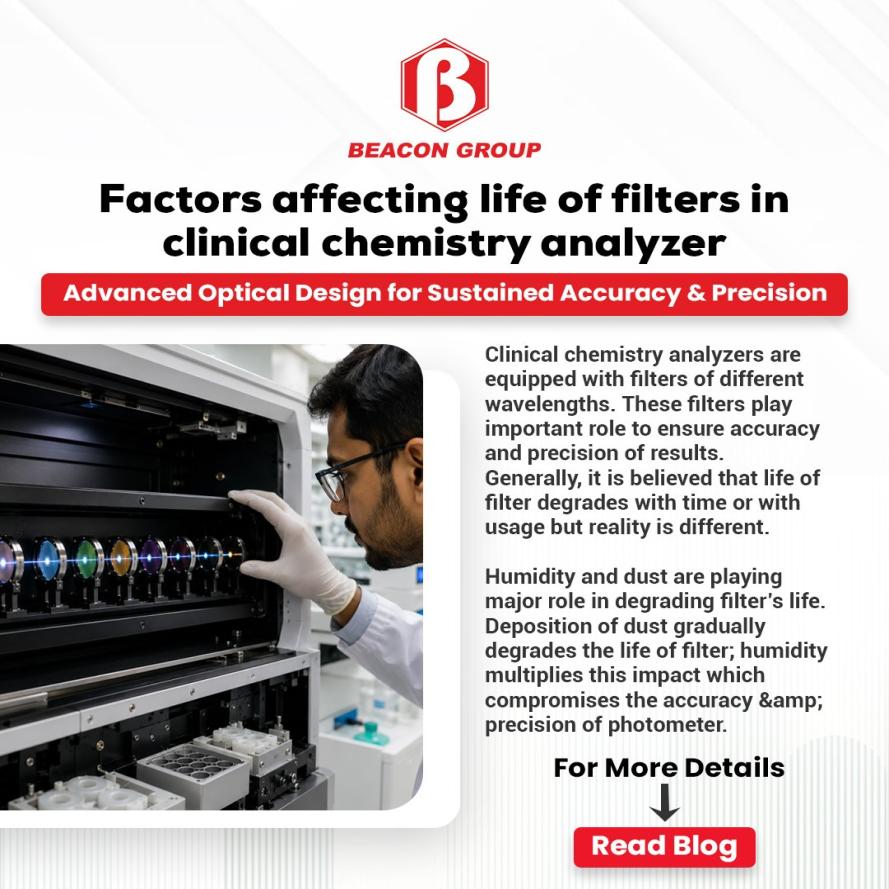
Clinical chemistry analyzers are equipped with filters of different wavelengths. These filters play important role to ensure accuracy and precision of results. Generally, it is believed that life of filter degrades with time or with usage but reality is different.
Humidity and dust are playing major role in degrading filter’s life. Deposition of dust gradually degrades the life of filter; humidity multiplies this impact which compromises the accuracy & precision of photometer.
Photometer of most of the clinical chemistry analyzers are equipped with moving parts like filter wheel. Due to the presence of moving parts, it is not possible to completely close the photometer. As photometer is not completely closed, dust and humidly keep on entering inside the photometer, which results in degradation of filter’s life.
Some manufacturers of high end fully automatic clinical chemistry analyzers have addressed this problem. They remove moving parts (like filter wheel) from the photometer and put all filters in a straight line. Removal of moving parts, makes it possible to completely close the photometer. Completely closed photometer mince no deposition of dust on filters, which results in accuracy and precision of photometer (quality of light) for long period of time.
This completely closed photometer is called static photometer because it is not having moving parts.
Beacon group of companies are offering full range of clinical chemistry analyzers having throughput of 100, 200, 400 and 800 tests / hour. These clinical chemistry analyzers are equipped with advance static photometer.

Beacon Group
424, New GIDC, Kabilpore, Navsari, Gujarat 396424 India

Beacon Diagnostics Europe Srl.
Via Aliprandi 41, 20851, Lissone(MB), Italy

Beacon Diagnostics - Spain
C/Sicilia 159, 08013, Barcelona, Spain

Beacon Diagnostics-Philippines
Unit 108 Two Premier 1st St. Alabang Premier, Alabang Zapote Rd, Concha Cruz Drive, Almanza Uno, Las Pinas City