

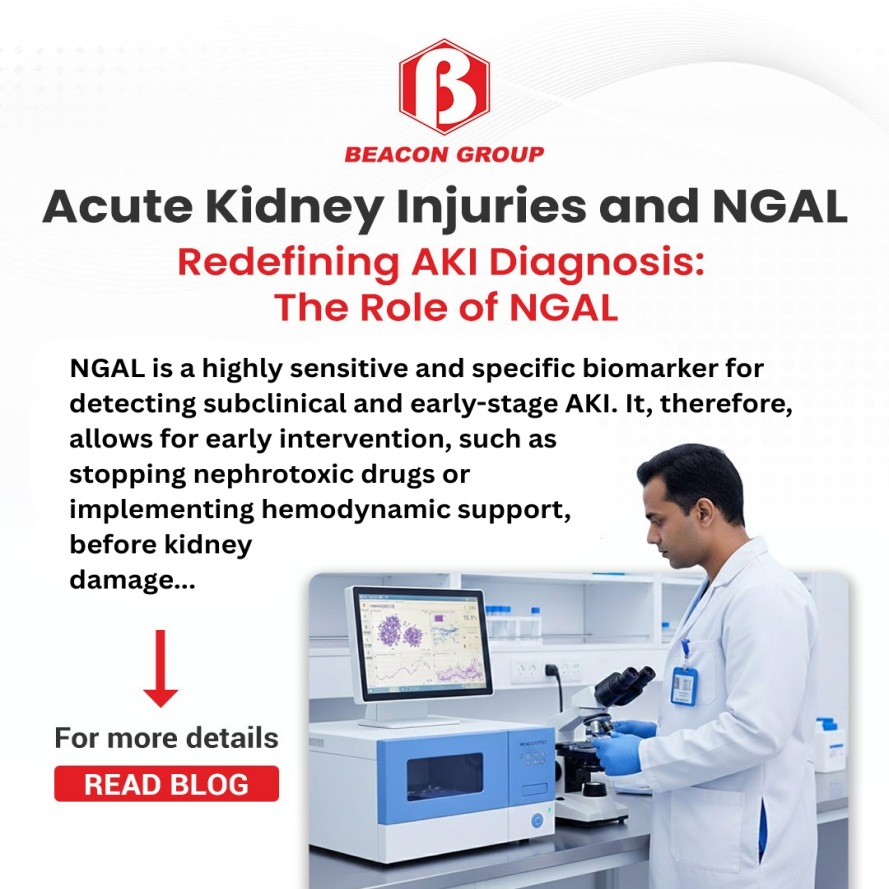
Neutrophil Gelatinase Associated Lipocalin (NGAL) is a premier, early-response biomarker for Acute Kidney Injury (AKI), enabling diagnosis hours to days before traditional serum creatinine (SCr) rises. Urine (uNGAL) and plasma (pNGAL) levels rise rapidly following structural renal damage, particularly in cardiac surgery, sepsis, and transplantation, offering high sensitivity for predicting severe AKI, dialysis initiation, and mortality.
Clinical Use of NGAL in AKI:
NGAL is a highly sensitive and specific biomarker for detecting subclinical and early-stage AKI. It, therefore, allows for early intervention, such as stopping nephrotoxic drugs or implementing hemodynamic support, before kidney damage becomes irreversible. In the Emergency Department and ICUs, NGAL helps distinguish true intrinsic AKI (structural damage) from transient prerenal azotemia.
Higher, sustained levels of NGAL are strongly associated with higher risk of dialysis requirement (Renal Replacement Therapy), prolonged ICU stay, and mortality. NGAL is highly effective in detecting AKI in high-risk, homogeneous scenarios like paediatric and adult cardiac surgery, contrast-induced nephropathy, and transplantation.
Although primarily derived from the renal tubules, high levels of NGAL can be influenced by systemic infection, inflammation, chronic kidney disease (CKD), and malignancy, particularly for plasma measurements. While SCr measures functional loss (slow), NGAL measures structural injury (fast). It serves as a rapid "point-of-care" tool to identify patients who need close monitoring, and in some contexts, as a, "rule-out" test for AKI.
Limitations to be considered:
Its performance can vary in heterogeneous ICU populations where the timing of injury is unknown. Moreover, Lack of standardized, universal cut-off values hinders widespread routine clinical use.

Beacon Group
424, New GIDC, Kabilpore, Navsari, Gujarat 396424 India

Beacon Diagnostics Europe Srl.
Via Aliprandi 41, 20851, Lissone(MB), Italy

Beacon Diagnostics - Spain
C/Sicilia 159, 08013, Barcelona, Spain

Beacon Diagnostics-Philippines
Unit 108 Two Premier 1st St. Alabang Premier, Alabang Zapote Rd, Concha Cruz Drive, Almanza Uno, Las Pinas City