

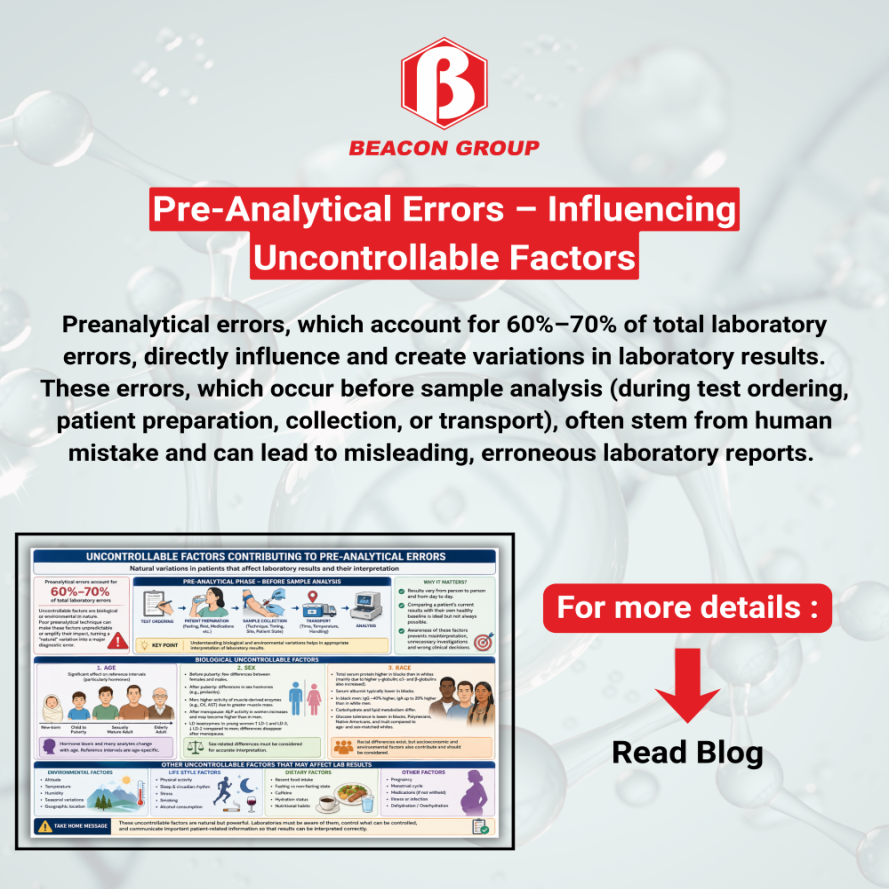
Preanalytical errors, which account for 60%–70% of total laboratory errors, directly influence and create variations in laboratory results. These errors, which occur before sample analysis (during test ordering, patient preparation, collection, or transport), often stem from human mistake and can lead to misleading, erroneous laboratory reports.
Amongst these errors there are controllable and uncontrollable factors contributing to the errors. We have already seen the details for controllable errors in our previous blog, now in this citation we will try to understand about uncontrollable factors contributing to Pre-Analytical errors.
While "uncontrollable" factors are typically defined as biological (age, sex, race) or environmental (altitude), poor preanalytical technique can make these factors unpredictable or amplify their impact, turning a "natural" variation into a major diagnostic error.
Historical Perspective
In daily clinical practice little attention is usually given to the factors other than disease that may affect clinical laboratory data. As early as the 1950s, RJ Williams emphasized the importance of biological variability in influencing the concentration of different constituents in body fluids of different healthy individuals. In the 1960s, GZ Williams stated that the ideal approach to interpretation of laboratory data would be a comparison of data in an individual when he is ill with the individual's own data when he is known to be healthy. However, this is usually impossible in practice and also, the concentration of an analyte varies in each individual from day to day. In addition, there are numerous other factors ranging from seasonal influences to analytical effects that may modify laboratory data so that problems in interpretation arise.
The biological uncontrollable factors that will create impact on Laboratory results need careful understanding of them in order to generate appropriate interpretation of results.
1. Age
Age has a notable effect on reference intervals (particularly hormones), although the degree of change differs in various reports and may be dependent upon the analytical method used. In general, individuals are considered in groups — the new-born, the older child to puberty, the sexually mature adult, and the elderly adult.
2. Sex
Until puberty, few differences in laboratory data are noted between young female and male humans. After puberty characteristic changes in the concentrations of sex hormones, including prolactin, become apparent. Also after puberty, higher activity of enzymes originating from skeletal muscle in men is related to their greater muscle mass. After menopause, the activity of ALP increases in women until it is higher than in men. Although total LD activity is similar in men and women, the activities of the LD-1 and LD-3 isoenzymes are higher, and LD-2 is less, in young women than in men. These differences disappear after menopause.
3. Race
Differentiation of the effects of race from those of socioeconomic conditions is often difficult, as may be the determination of the race of the patient. However, the total serum protein concentration is known to be higher in blacks than in whites. This is largely attributable to a much higher γ-globulin, although usually the concentrations of α1- and β-globulins are also increased. The serum albumin is typically less in blacks than in whites. In black men, serum IgG is often 40% higher, and serum IgA may be as much as 20% higher, than in white men. Carbohydrate and lipid metabolism differs in blacks and whites. Glucose tolerance is less in blacks, Polynesians, Native Americans, and Inuit than in comparable age- and sex-matched whites.
Other Contributing Factors
In addition to these Biological Variables there are other factors like environmental factors, Life Style, Diet etc may also contribute to Pre-Analytical errors. The need for laboratories is to take care of such factors before providing the result to the patient.

Beacon Group
424, New GIDC, Kabilpore, Navsari, Gujarat 396424 India

Beacon Diagnostics Europe Srl.
Via Aliprandi 41, 20851, Lissone(MB), Italy

Beacon Diagnostics - Spain
C/Sicilia 159, 08013, Barcelona, Spain

Beacon Diagnostics-Philippines
Unit 108 Two Premier 1st St. Alabang Premier, Alabang Zapote Rd, Concha Cruz Drive, Almanza Uno, Las Pinas City