

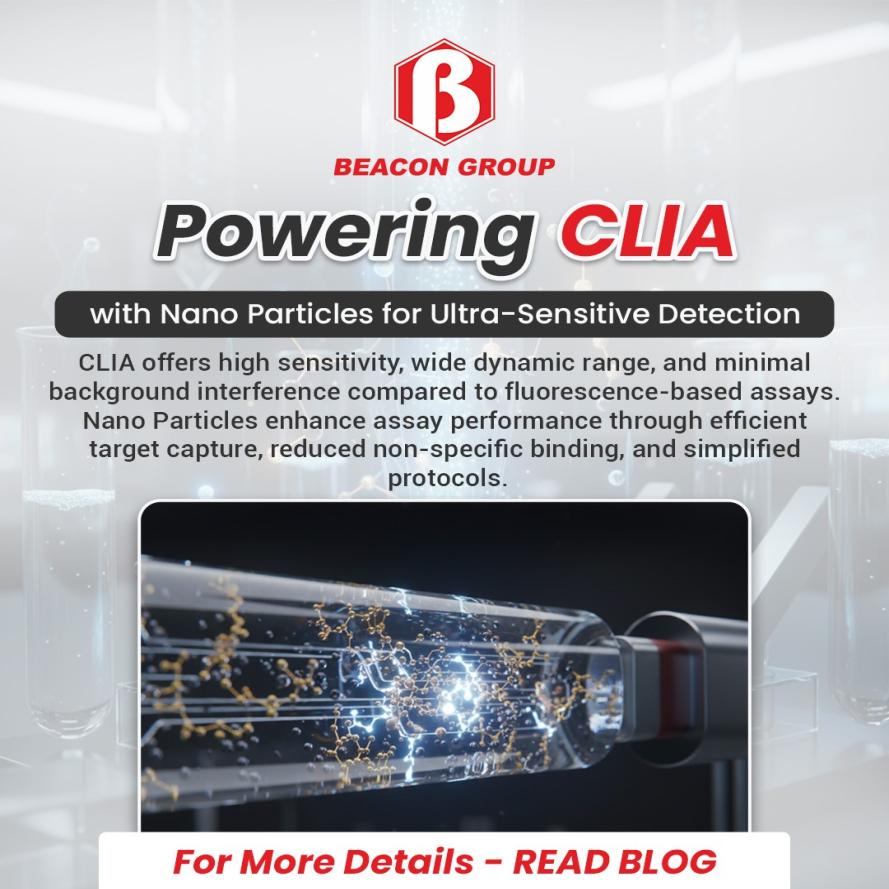
Use of Nano Particles in CLIA
Luminescence is the emission of light, and it can occur in many ways. In research and biomedical industry fluorescence and chemiluminescence are often used. Fluorescence is when light is absorbed then emitted by a substance. A photon of a higher energy state is absorbed, then a lower energy photon is emitted in another range of the electromagnetic spectrum. On the other hand, chemiluminescence (CL) is the conversion of the chemical energy into the emission of visible light as the result of an oxidation or hydrolysis reaction.
A major advantage of chemiluminescent immunoassays is the simplicity of the detector needed to record data. Chemiluminescence emits light without the need of excitation from a light source or a detector for a wide range of wavelengths not in the visible spectrum. This is also advantageous because there will be no background from the substance being observed, since the only light emitted will be from the chemiluminescent reaction. Unlike in fluorescent as says where autofluorescence is an issue to monitor. Chemiluminescence also doesn’t require separation of absorption and emission wavelengths to understand the readout, it is more direct.
The combination of CLIA and Nano Particles brings together all the advantages of both parts. CLIA is known for its high sensitivity which allows the detection of analytes at very low concentrations, and thus providing an excellent limit of detection in a wide dynamic range. Nano Particles, on the other hand, are known for their simple protocols which help minimizing and even eliminating potential sources of error that occur in complex systems. Nano Particles reduce the incidence of non-specific interactions during the capture and isolation processes. In addition, due to their large spherical surface area, Nano Particles allow for a more efficient binding to the target substance.
Common Nano Particles used include gold nanoparticles (AuNPs), magnetic nanoparticles (MNPs), quantum dots, and carbon nanotubes (CNTs), often functionalized to improve signal intensity and assay performance, surpassing traditional methods like ELISA.
In case of CLIA technologies as described earlier separation is a crucial part between each binding step. Unbound material must be removed as effectively as possible using the optimum magnetic set up. Magnetic Nano Particles can be functionalized according to the assay that is required to the target analyte. For example, using CLIA to detect an antibody such as SARS-CoV-2 IgG, the first step will be to incubate the sample that can contain SARS-CoV-2 IgG antibodies to the magnetic beads, which are previously surface-functiona lized with specific antigen/s that allow the antibodies to bind to the surface of the magnetic Nano Particles. Magnetic Nano Particles will capture only the target antibody of interest, which will increase the specificity of the assay at this crucial step.

Beacon Group
424, New GIDC, Kabilpore, Navsari, Gujarat 396424 India

Beacon Diagnostics Europe Srl.
Via Aliprandi 41, 20851, Lissone(MB), Italy

Beacon Diagnostics - Spain
C/Sicilia 159, 08013, Barcelona, Spain

Beacon Diagnostics-Philippines
Unit 108 Two Premier 1st St. Alabang Premier, Alabang Zapote Rd, Concha Cruz Drive, Almanza Uno, Las Pinas City