

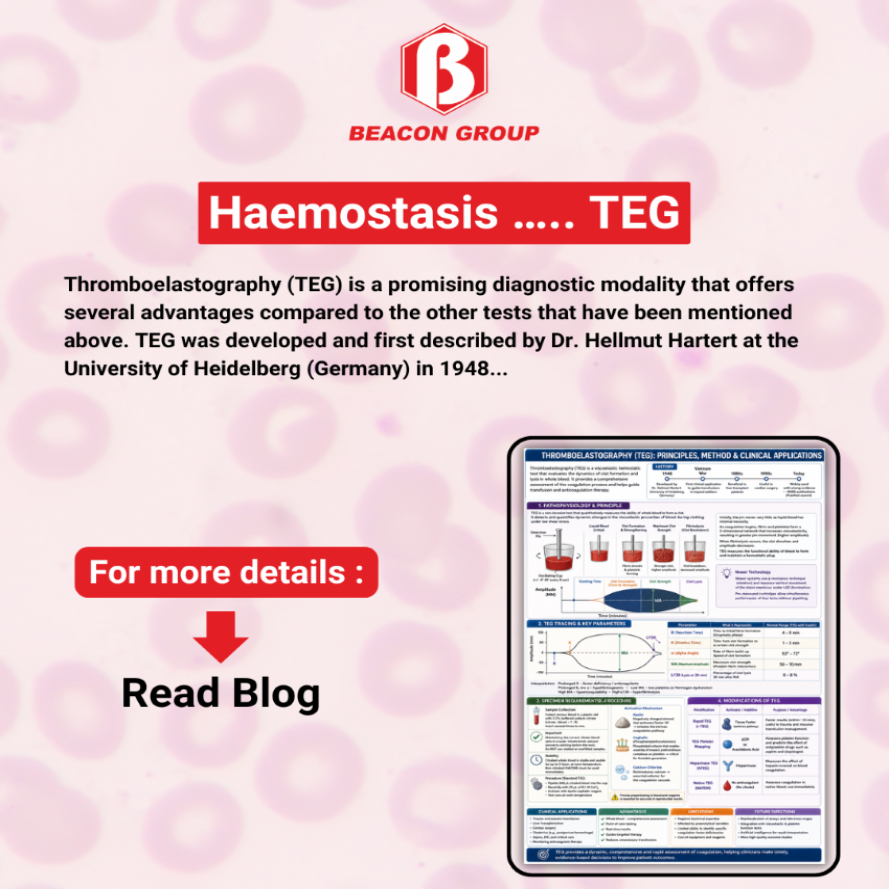
Thromboelastography (TEG) is a promising diagnostic modality that offers several advantages compared to the other tests that have been mentioned above. TEG was developed and first described by Dr. Hellmut Hartert at the University of Heidelberg (Germany) in 1948. The first reported clinical application of the test occurred during the Vietnam War in an attempt to guide transfusions of blood components in injured soldiers. In the 1980s, TEG was found to be beneficial in liver transplant patients, and in the 1990s, it was demonstrated to be useful in cardiac surgery. Since then, TEG has evolved into a more commonly used test as more evidence for its clinical efficacy has been attained. A brief search in PubMed using keywords “thromboelastography” and “thromboelastometry” results in about 6000 publications. This article will describe the general principles of TEG, methodology, normal values, along with the current evidence and clinical applications, as well as limitations and future research directions.
Pathophysiology
TEG is a non-invasive test that quantitatively measures the ability of whole blood to form a clot. The principle of this in vitro test is to detect and quantify dynamic changes of the viscoelastic properties of a blood sample during clotting under low shear stress. The test is performed in a specially designed system called a thromboelastograph. The system consists of 2 chambers simultaneously examining a blood sample in duplicate to reduce the risk of sampling and measurement errors. Each chamber consists of a platform with a disposable cup where a blood sample is placed and a detection pin suspended in its center. The cup oscillates around the detection pin in a limited arc of plus or minus (+/-) 4 degrees 45' every 5 seconds. Induced pin movement is recorded, and changes are measured as a function of time. Initially, there is little movement of the pin since liquid blood possesses minimal viscosity, and the oscillations of the cup are not transmitted to the pin.
As the blood coagulates, it begins to adhere to both the cup and the pin, and movement of the cup induces motion on the pin. These gradually increasing viscoelastic mechanical properties of the blood reflect the developing 3-dimensional fibrin mesh and platelet components of the clot. The greater the viscoelasticity of the clot, the higher the amplitude of the pin motion. As fibrinolysis starts, the fibrin-platelet structure begins to dissolve gradually, and the clot loses its contact with the detection pin, which has less induced motion. The thromboelastogram is a graphical image of the recorded amplitude of movement of the pin as a function of time. Analytical software measures and quantifies these changes. Therefore, TEG measures the functional ability of the blood to make a haemostatic plug. A newer version replaces the cup rotation method with a resonance technique wherein the blood sample is subjected to vibration, and the vertical movement of the blood meniscus is measured under LED illumination. The system uses pre-measured cartridges that do not require pipetting and allows the simultaneous performance of four blood tests.
Specimen Requirements and Procedure
The blood sample is collected via venipuncture in a plastic vial with 3.2% buffered sodium citrate with a citrate-to-blood ratio of 1:9. The vial is inverted several times to mix the blood and citrate. Maintaining this citrate-blood ratio is crucial for test accuracy. Citrate binds calcium, an important cofactor of coagulation, preventing the blood from clotting before the beginning of the test. A clotted specimen, reflecting a vial overfilled with blood, cannot be used. For TEG testing, the collected non-clotted samples are considered stable and usable for up to 2 hours at room temperature. Non-citrated whole blood (native blood TEG or NATEM) can also be tested, but it must be used immediately. The test and reagents used are at room temperature. A volume of 340 uL of citrated blood is pipetted to the study cup, recalcified by the addition of 20 uL of 0.2M calcium chloride, and then activated with a kaolin-cephalin reagent. Cephalins, or phosphatidylethanolamines, are a class of phospholipids commonly present in membranes of human cells. They are an important cofactor of the coagulation cascade, enabling the assembly of tenase and prothrombinase complexes on the surface of platelets that are critical for thrombin generation. Kaolin is a mineral primarily composed of hydrated aluminum silicate, a negatively charged molecule that can initiate the intrinsic coagulation pathway by activating Factor XII. Precise proportioning of the blood and kaolin-cephalin reagent is important for accurate and reproducible TEG results. Non-activated TEG is also possible, but the lack of activators significantly prolongs clotting time and the testing process, which is not desirable in a clinical emergency.
Several modifications of the classic TEG assay have been developed to improve its diagnostic value. Rapid TEG (r-TEG) utilizes tissue factor instead of the kaolin-cephalin reagent to activate blood coagulation. Because tissue factor triggers the extrinsic coagulation pathway, which involves a smaller number of coagulation factors, the test can be performed faster than conventional TEG. Rapid TEG can be completed within 15 minutes and thus helps manage massive transfusions in trauma patients. The TEG platelet mapping assay was developed to predict the inhibitory effect of antiplatelet agents such as aspirin and clopidogrel. This is accomplished by evaluating platelet aggregation in the presence of adenosine diphosphate or arachidonic acid. TEG with added heparinase (hTEG) measures the effect of heparin reversal on blood coagulation.

Beacon Group
424, New GIDC, Kabilpore, Navsari, Gujarat 396424 India

Beacon Diagnostics Europe Srl.
Via Aliprandi 41, 20851, Lissone(MB), Italy

Beacon Diagnostics - Spain
C/Sicilia 159, 08013, Barcelona, Spain

Beacon Diagnostics-Philippines
Unit 108 Two Premier 1st St. Alabang Premier, Alabang Zapote Rd, Concha Cruz Drive, Almanza Uno, Las Pinas City