

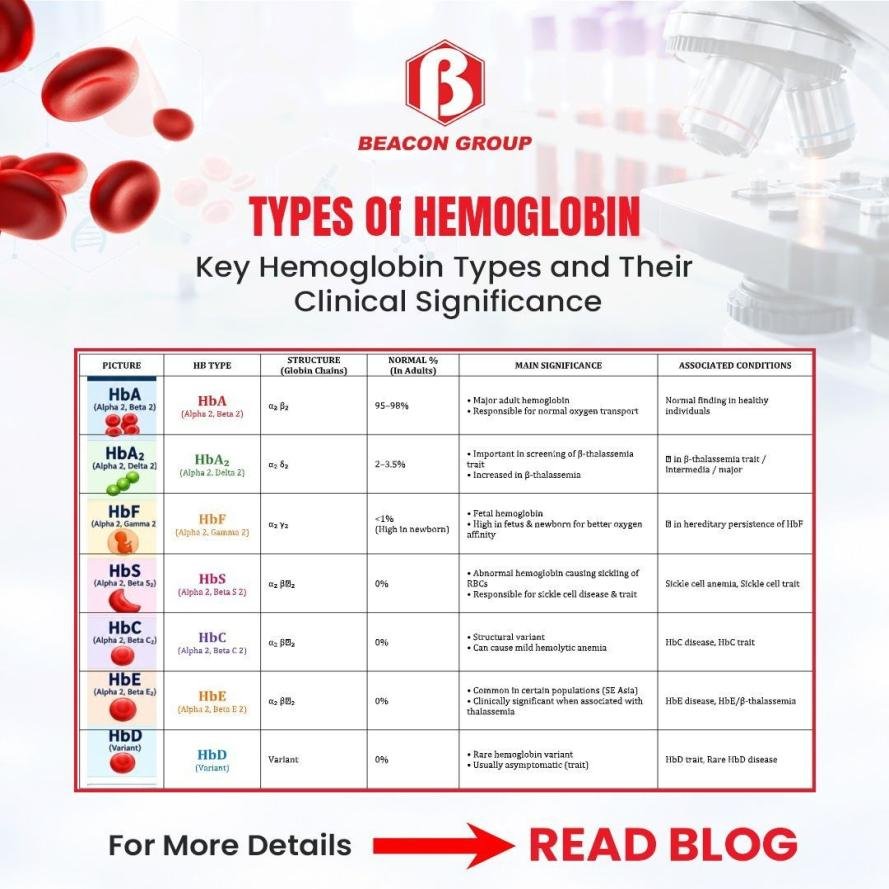
Types of Hemoglobin (Hb)
Key Hemoglobin Types and Their Clinical Significance
Laboratory Identification
Hemoglobin variants are identified by HPLC, Hemoglobin Electrophoresis,
HbA - Adult Hemoglobin
HbA is the major hemoglobin in healthy adults, comprising approximately 95–98% of total hemoglobin.
It consists of two alpha (α₂) and two beta (β₂) globin chains.
HbA is primarily responsible for oxygen transport from the lungs to tissues.
Normal HbA levels generally indicate normal adult hemoglobin production.
HbA₂ - Hemoglobin A₂
HbA₂ consists of two alpha and two delta chains (α₂δ₂).
It normally represents approximately 2–3.5% of adult hemoglobin.
HbA₂ measurement is particularly important for screening and diagnosis of β-thalassemia trait.
An increased HbA₂ level is a common laboratory indicator of β-thalassemia carrier status.
HbF - Fetal Hemoglobin
HbF consists of two alpha and two gamma chains (α₂γ₂).
It is the predominant hemoglobin during fetal life and the early newborn period.
HbF has a higher affinity for oxygen, helping the fetus obtain oxygen from maternal blood.
In healthy adults, HbF is usually less than 1%, although increased levels can occur in several inherited conditions.
HbS - Sickle Hemoglobin
HbS is a structural variant of hemoglobin caused by a mutation in the β-globin gene.
It can polymerize under low-oxygen conditions, causing red blood cells to become sickle-shaped.
HbS is associated with sickle cell trait and sickle cell disease.
Laboratory identification is important for diagnosis, carrier detection and clinical management.
HbC - Hemoglobin C
HbC is a structural β-globin variant resulting from a mutation in the beta-globin gene.
HbC may be present in the heterozygous state as HbC trait, which is often clinically mild.
Homozygous HbC disease can produce mild hemolytic anemia and splenomegaly.
HbC can be identified by HPLC, electrophoresis or capillary electrophoresis.
HbE - Hemoglobin E
HbE is a common hemoglobin variant, particularly among populations in South and Southeast Asia.
It results from a β-globin variant that also affects β-globin RNA processing.
HbE trait is generally mild or asymptomatic.
HbE becomes particularly important when inherited together with β-thalassemia, which can produce clinically significant disease.
HbD - Hemoglobin D
HbD represents a group of structural hemoglobin variants involving the β-globin chain.
HbD trait is generally asymptomatic and may be discovered incidentally during hemoglobin analysis.
Some HbD variants can be clinically significant when combined with other abnormal hemoglobins.
Accurate identification by HPLC or electrophoresis helps distinguish HbD from other variants.
Important laboratory note: Hb variants should be interpreted together with the patient’s CBC, MCV/MCH, HbA₂/HbF levels and the chromatographic/electrophoretic pattern rather than by a single percentage alone.
Quick Memory
Understanding Hb types helps in accurate diagnosis and better patient care.

Beacon Group
424, New GIDC, Kabilpore, Navsari, Gujarat 396424 India

Beacon Diagnostics Europe Srl.
Via Aliprandi 41, 20851, Lissone(MB), Italy

Beacon Diagnostics - Spain
C/Sicilia 159, 08013, Barcelona, Spain

Beacon Diagnostics-Philippines
Unit 108 Two Premier 1st St. Alabang Premier, Alabang Zapote Rd, Concha Cruz Drive, Almanza Uno, Las Pinas City