

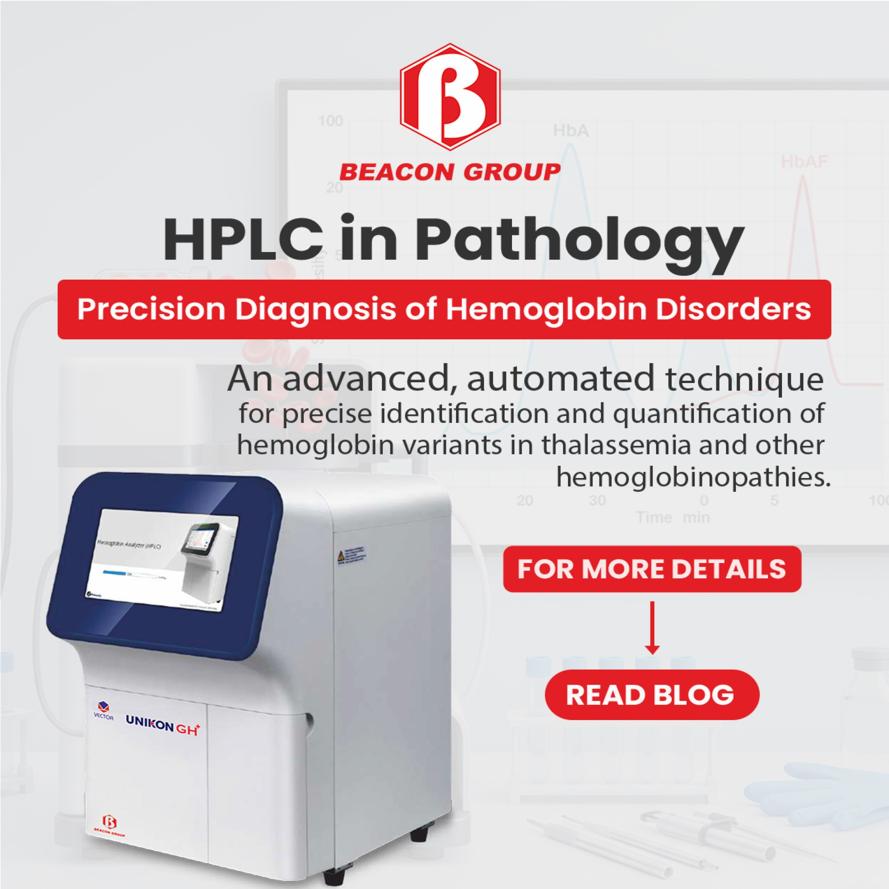
High-Performance Liquid Chromatography (HPLC) is a crucial analytical technique in pathology which is used primarily in hematology to separate and quantify different types of hemoglobin. This is vital for the diagnosis and monitoring of blood disorders like thalassemia and sickle cell disease by identifying and measuring normal and abnormal hemoglobin variants, such as HbA, HbA2, and HbF.
In order to perform this technique, A small blood sample is taken, and the red blood cells are broken open to release the hemoglobin. The hemoglobin is then passed through an HPLC machine, which uses a liquid mobile phase and a stationary phase to separate the different hemoglobin types based on their unique chemical and physical properties. A detector measures the separated hemoglobin molecules, and the results are displayed as a chromatogram, with different peaks representing different hemoglobin types.
HPLC accurately diagnoses conditions like thalassemia and sickle cell disease by detecting and quantifying the various hemoglobin types present. It can be used to monitor the effectiveness of treatment for these blood disorders.
The technique can quickly identify a wide range of hemoglobin variants, which can be important for early diagnosis and family planning. It provides precise quantification of hemoglobin fractions, such as HbA, HbA2, and HbF, which is essential for accurate diagnosis.
For Hemoglobinopathy electrophoresis is also used, however HPLC is a more automated, faster, and precise method that quantifies hemoglobin levels, while traditional electrophoresis is a slower, more manual technique that can be a cost-effective screening tool. Both methods can identify common hemoglobinopathies, but HPLC often has better resolution, accuracy, and the ability to detect rarer variants, especially when compared to manual gel electrophoresis. Capillary zone electrophoresis (CZE), a type of automated electrophoresis, offers a good compromise with high resolution and automation, though it can sometimes have different quantitative results for certain hemoglobin types compared to HPLC.
Thus HPLC is a sensitive, precise method and has become preferred method for thalassemia and other hemoglobinopathies due to it’s simplicity, superior resolution, rapid assay time as well as accurate quantification of Hb fractions.

Beacon Group
424, New GIDC, Kabilpore, Navsari, Gujarat 396424 India

Beacon Diagnostics Europe Srl.
Via Aliprandi 41, 20851, Lissone(MB), Italy

Beacon Diagnostics - Spain
C/Sicilia 159, 08013, Barcelona, Spain

Beacon Diagnostics-Philippines
Unit 108 Two Premier 1st St. Alabang Premier, Alabang Zapote Rd, Concha Cruz Drive, Almanza Uno, Las Pinas City