

(continue from Blog 3 26-27)
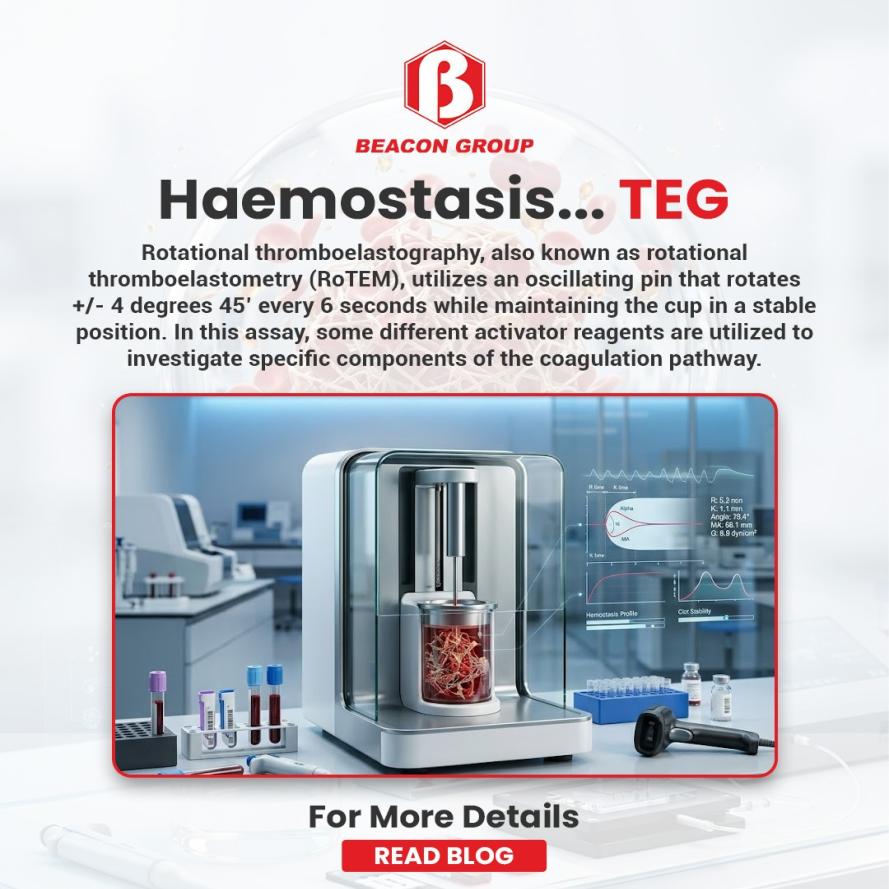
Rotational thromboelastography, also known as rotational thromboelastometry (RoTEM), utilizes an oscillating pin that rotates +/- 4 degrees 45' every 6 seconds while maintaining the cup in a stable position. In this assay, some different activator reagents are utilized to investigate specific components of the coagulation pathway.
Results, Reporting, Critical Findings
A normal thromboelastogram is schematically represented in Figure 1. Prompt qualitative analysis of the TEG tracing can be performed during the test. The quantitative analysis of TEG includes the measurement of the 5 parameters listed and described in Table 1. The manufacturer has also suggested a coagulation index to assess the overall coagulation status.
The coagulation index (CI) for whole blood may be calculated as follows:
Normal values of the coagulation index lie within -3.0 and +3.0, which is three standard deviations from the mean of zero. A hypercoagulable state is defined as CI greater than +3.0 and coagulopathy as CI less than -3.0. Previous studies demonstrated a significantly elevated CI in the postoperative period after general surgery and in cancer patients, suggesting a prothrombotic state. However, this index is not widely used, and its clinical usefulness is not yet validated. Several other parameters may be calculated based on the thromboelastogram, such as projected maximal amplitude, time to maximal amplitude, the G parameter (shear elastic modulus strength, or clot strength), and a thrombodynamic potential index. While providing interesting information, these variables are rarely used in clinical practice.
Normal TEG values are presented in Table 2, although some patient-related factors may affect these values. Elderly patients tend towards more pro-coagulable TEG results, suggesting a need to correct these reference values in the elderly. In some circumstances, such as in patients undergoing cardiac surgery and liver transplantation, specific reference values are less important because the principal application of TEG is to compare the patient’s own baseline to changes during the intraoperative and postoperative periods. In other clinical scenarios, such as trauma or postoperative bleeding, reference values are important for interpreting the results as no baseline data is available. There is also some variability in testing results. A study on 118 healthy volunteers revealed at least one abnormal parameter in 19% of specimens, and a coagulopathy (defined as at least 2 abnormal parameters) in 9%, leading to a calculated specificity of 81%. A larger prospective trial of a more diverse group of subjects would be helpful to establish analyzer-specific and reagent-specific reference values in selected subgroups of patients.
Deviation of each of these TEG parameters from the reference values suggests specific disturbances of hemostasis and coagulation. Prolongation of the R time reflects a quantitative or qualitative deficiency of coagulation factors that may be corrected by fresh frozen plasma (FFP) transfusion, prothrombin complex, or anticoagulant reversal. Prolongation of the K time, or a decrease of the alfa angle, suggests a deficiency of fibrinogen and may be corrected by cryoprecipitate or lyophilized fibrinogen concentrate. Low MA indicates a quantitative or functional deficiency of platelets and could be corrected by platelet concentrate transfusion or desmopressin. Finally, an increased LY value implies activated fibrinolysis that may be treated by fibrinolysis inhibitors (aminocaproic or tranexamic acid). The opposite changes in TEG parameters suggest a prothrombotic state.
This interpretive approach represents a convenient but rather simplified view on disturbances of blood coagulation. It is important to remember that these TEG parameters are interrelated due to the complex nature of hemostasis.

Beacon Group
424, New GIDC, Kabilpore, Navsari, Gujarat 396424 India

Beacon Diagnostics Europe Srl.
Via Aliprandi 41, 20851, Lissone(MB), Italy

Beacon Diagnostics - Spain
C/Sicilia 159, 08013, Barcelona, Spain

Beacon Diagnostics-Philippines
Unit 108 Two Premier 1st St. Alabang Premier, Alabang Zapote Rd, Concha Cruz Drive, Almanza Uno, Las Pinas City